
Money Management
Optimal Risk Management Framework
If Warren Buffett and Bill Gross use it — why not you and I? The Kelly Criterion, optimized for horse racing.
Educational Risk Management Framework
This section introduces a well-known mathematical approach to risk allocation called the Kelly Criterion, originally described by J. L. Kelly, Jr. in 1956. The Kelly Criterion is a probabilistic formula used in fields such as investment theory and decision modeling to help determine optimal position sizing when an edge is believed to exist.
The framework has been studied extensively in mainstream finance and is sometimes referenced by successful investors (including claims regarding figures like Warren Buffett and Bill Gross) as one tool among many for long-term capital growth. While it originated in information theory and has been applied to stock-market analysis, the same underlying mathematics can serve as an educational example for understanding probability, expected value, and risk control in any data-driven scenario — including the analysis of thoroughbred racing statistics.
Kelly Criterion
Described by J. L. Kelly Jr. in 1956, this formula has been shown in theoretical models to outperform any essentially different strategy for long-term growth of capital when a true probabilistic edge exists.
Fractional Kelly
To reduce extreme volatility in simulations, a fractional version of the criterion is often applied. This means never allocating more than a conservative percentage of total available capital, even when the full formula suggests a larger portion.
Capital Protection Mechanism
Even in scenarios where the model indicates a high allocation (e.g., 30%+), the framework includes a hard cap to help protect capital during extended periods of underperformance in simulations.
Long-Run Growth Illustration
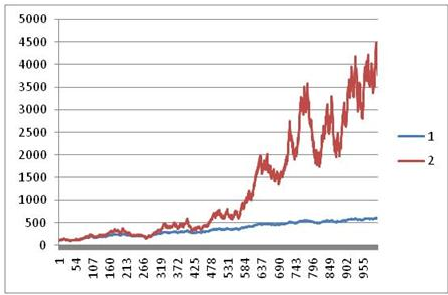
Historical simulations (such as 1,000-run Monte Carlo tests) demonstrate that consistent application of Kelly-based allocation principles can lead to significantly faster growth of starting capital compared to simple fixed-percentage approaches — purely as a mathematical observation for educational purposes.
Kelly Criterion vs. Fixed Allocation — Simulation Example
Over 1,000 simulated iterations, the Kelly Criterion allocation approach typically demonstrates substantially faster growth of starting capital than a fixed-percentage method. While early results may exhibit greater volatility, the model highlights the potential long-term mathematical advantage in scenarios where an edge exists.
Reducing Volatility with Fractional Kelly
To decrease volatility in the simulations, a fractional Kelly approach is recommended. This method uses only a conservative fraction of the full Kelly-suggested allocation size. In addition, the framework includes a hard cap that never allows the simulated allocation to exceed a predefined maximum percentage of total available capital — regardless of how high the model's estimated probability may be.
For example, even in cases where the full Kelly formula suggests allocating over 30% of starting capital, the system applies a strict upper limit to help protect the simulated capital during periods of underperformance.