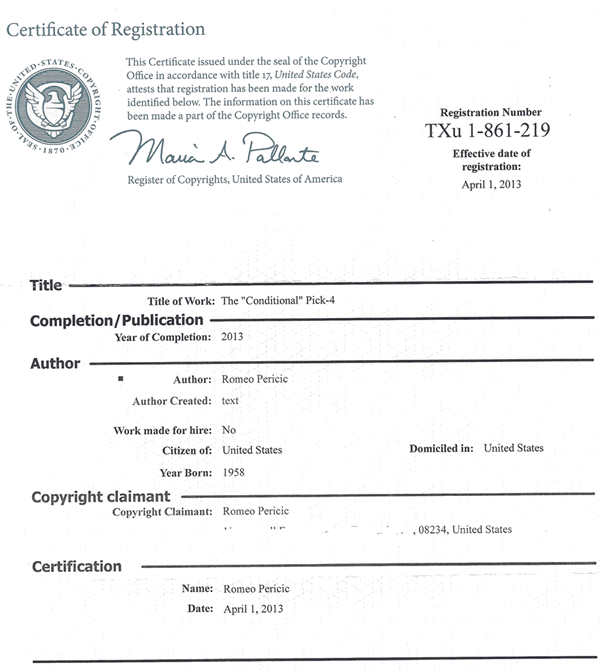
Copyrighted System
The "Conditional" Pick-4©
Registration Number: TXu 1-861-219
Example: Combination Reduction in Multi-Leg Racing Sequences (Educational Illustration)
Consider a hypothetical 4-leg sequence using 3, 3, 4, and 5 possible outcomes in each leg respectively. The total number of possible combinations would be 180.
One approach, referred to here as a Conditional Sequence Reduction Method, demonstrates how the number of combinations can be reduced to 172, 132, 62, or even as low as 8, depending on the specific conditions applied — while keeping the same number of outcomes under consideration in each leg.
Crisscross Example (for illustration only)
In a simple 3 × 3 × 3 × 3 crisscross structure, the theoretical probability of covering all outcomes is approximately 12.96% (1 in roughly 7.7 attempts). If each base unit costs $2, the total cost for the full structure would be $162.00. To illustrate break-even mathematics in a purely theoretical sense: a successful covering outcome would need to return more than $1,100.00 (on average) once every 7.7 attempts to offset the cumulative cost in repeated simulations.
The purpose of exploring conditional reduction techniques is to show how the total number of combinations can be minimized without reducing the number of outcomes being analyzed. Several examples follow.
Please note: The material that follows is purely mathematical and educational. It is not difficult once the logic is understood, though explaining it clearly can take some care.
Example 1:
Pick-4 with 3, 3, 4, and 5 horses in consideration. Total combinations = 180 ($2.00 ticket playing all horses would cost $360.00). We like some horses more than others and those horses will be labeled as the Key Horses. In the first leg there is one key horse, second and third legs have 2 key horses, while the fourth leg has three key horses. Now, the condition must be set. The condition applies to the Key horses only. Whatever condition is set, it must be fulfilled. We have to ask ourselves: How many of the key horse legs can we pick correctly? 3 out of 4, 2 out of 4, or 1 out of 4. In this first example, the condition set is: 3 out of 4! (Applies to Key Horses column) Starting in the top left box, write in all combinations of 3 using only the KEY horses selected as depicted below.

What do we do with the empty boxes? Well, that depends on where the empty boxes are. If the empty boxes are to the right of the LAST Key entry (yellow), then the horses in the All Horses Considered column are inserted. In the above example only leg 1 has an empty box to the right of the last Key horse A. Thus, horses A, B, and C are entered in the last box of leg 1. In all other empty boxes, that is, all empty boxes to the left of the LAST Key entry (green), write in all horses in that particular leg that are not our Key plays. Therefore, in leg 2 - horse C, leg 3 - horses C and D, and in leg 4 - horses D and E. See completed chart below. The total number of combinations has been reduced from 180 to 62 (8+12+6+36 = 62) !!! As long as ANY 3 out of the 4 conditions are met, a winning ticket is guaranteed (assuming the winners are amongst all horses considered, of course)

Example 2:
Let's now assume we want only 2 conditions. The procedure is the same as above. First, insert all combinations of 2 using only Key Horses in the matrix. See below.

Now in leg 1, there are 3 empty boxes to the right of the last Key entry (yellow), thus, A, B, and C are inserted in all three boxes. In leg two, there is one empty box to the right of the last Key entry, thus A, B, and C are inserted and in the two empty boxes to the left, only C is inserted. In legs 3 and 4 there are no empty boxes to the right, thus C and D for leg 3 and D and E for leg 4 are entered in the empty boxes to the left. There are a total of 132 combinations (8+4+6+24+36+54 = 132) !!! See below:

Example 3:
Finally, for completeness sake, 1 condition. The procedure is the same.

The condition, 1 out of 4 is the easiest to fulfill and will reduce the number of combinations the least. The total number of combinations is 172 (4+24+36+108 = 172). See below:

Application to Other Multi-Leg Sequences (Educational Note)
The conditional reduction method described above can be applied to various multi-leg racing sequences, including the Pick-3 and Pick-6 formats.
One of its main advantages in a theoretical context is the ability to adapt the conditions race-by-race or day-by-day. This allows for the inclusion of any desired number of key outcomes or contenders while minimizing the total number of combinations under analysis.
Copyright